
If you are checking exponent rules review worksheet answers, the fastest way to confirm each problem is to match the expression with the correct rule before simplifying. Most worksheet errors come from mixing up rules or losing track of signs. A solid answer key should help you verify product, quotient, power of a power, zero exponent, and negative exponent problems step by step.
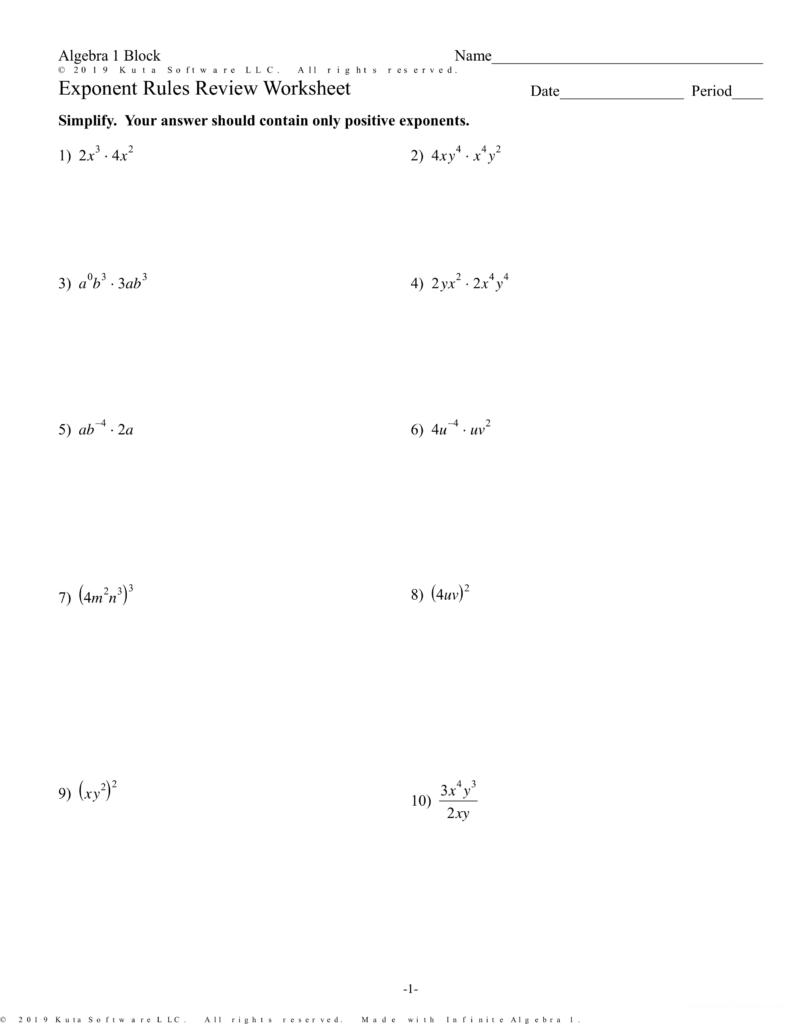
Product and quotient rules
Use the product rule when bases match: add the exponents, not the bases. For example, x^3 · x^5 = x^8. Use the quotient rule when dividing like bases: subtract the exponents. For example, y^9 / y^4 = y^5. A common mistake is to write x^3 · x^5 = x^15, which is wrong because exponents are not added that way. Another mistake is forgetting that the base must be the same before combining exponents. If the bases differ, you cannot use these rules directly.
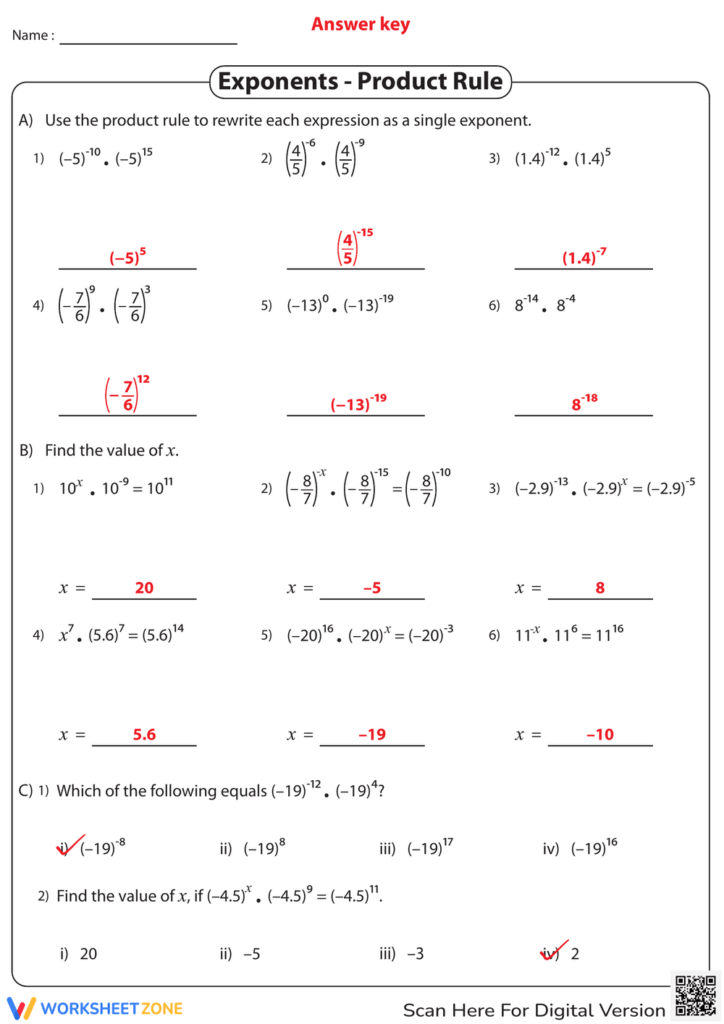
Powers and zero exponents
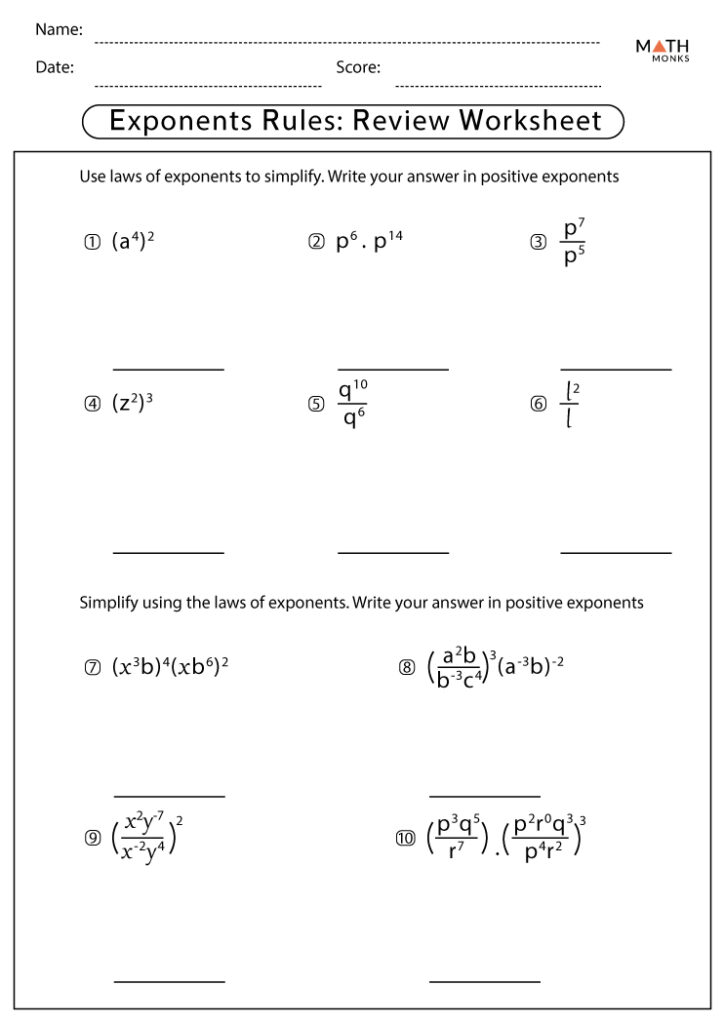
For a power of a power, multiply the exponents: (a^3)^4 = a^12. This rule is easy to miss because the outside exponent affects everything inside the parentheses. For zero exponents, any nonzero base raised to 0 equals 1, so 7^0 = 1 and (2x)^0 = 1 if the base is not zero. A frequent worksheet error is treating zero exponent problems like division by zero. They are not division problems; they simplify directly to 1. Check whether the entire base is enclosed in parentheses before deciding the result.
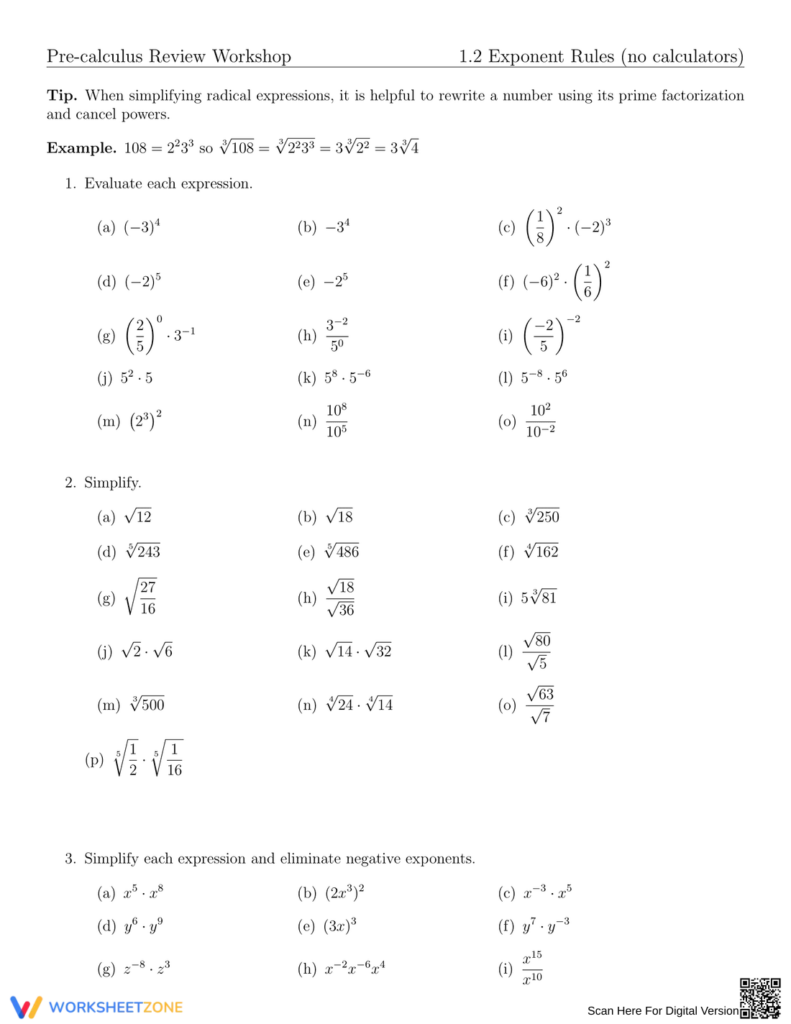
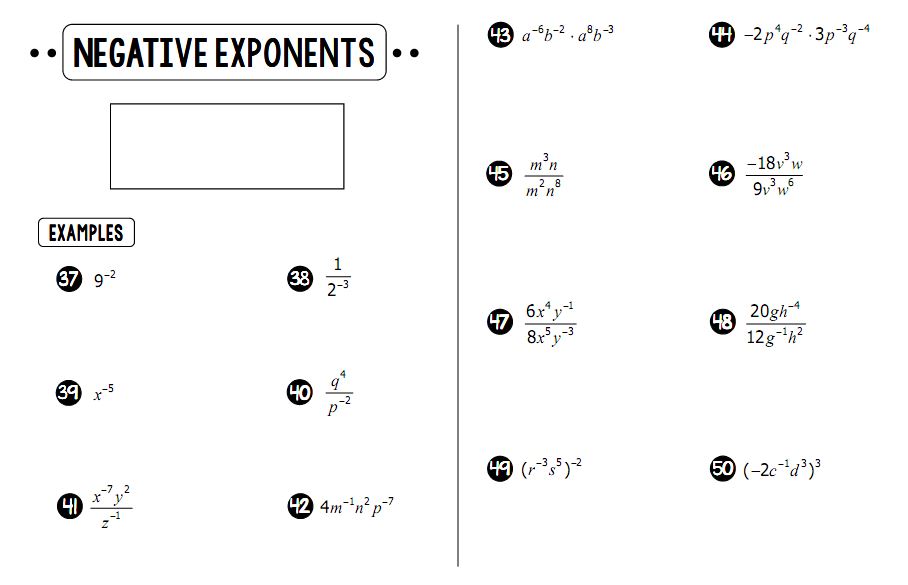
Negative exponents mean take the reciprocal and make the exponent positive: x^-4 = 1/x^4 and 3y^-2 = 3/y^2. If the negative exponent is in the denominator, move it to the numerator instead. For example, 1/a^-3 = a^3. The key mistake to avoid is leaving a negative exponent in a final answer when the worksheet asks for positive exponents only. Another common error is applying the negative sign to the base rather than the exponent.
When you review answers, make sure the sign stays with the exponent and the expression is fully simplified.



